Study Rooms 2026

Study Rooms 2026

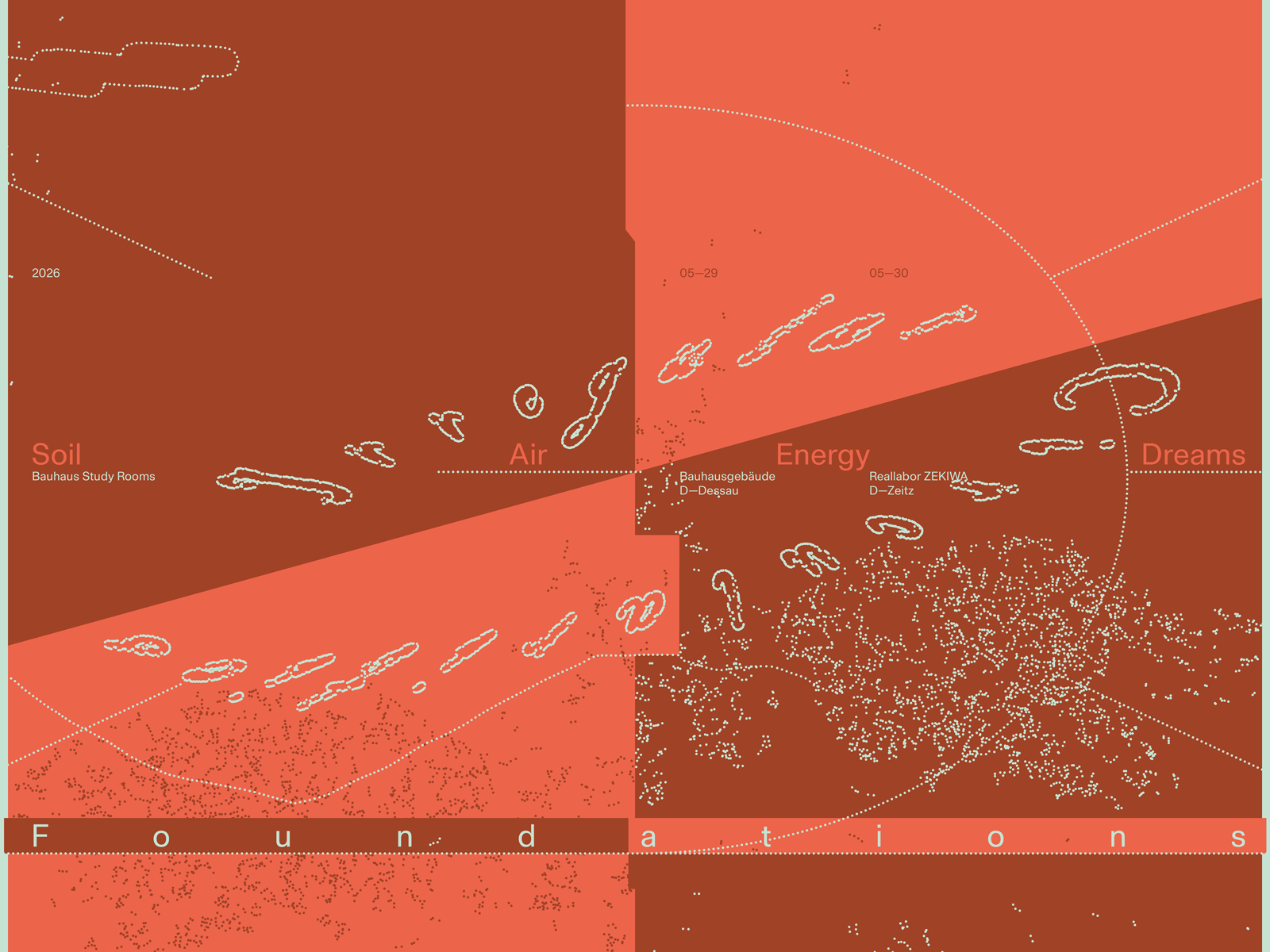
The Bauhaus Study Rooms 2026 focus on processes of transformation in regions shaped by industrial and post-industrial structural change.

The Bauhaus Study Rooms 2026 take place in cooperation with the International Summercamp Irregular Circularities as part of the Real-World Laboratory ZEKIWA Zeitz. They are dedicated to processes of transformation in regions shaped by industrial and post-industrial change. The Academy of the Bauhaus Dessau Foundation invites designers and researchers to follow the entanglements of industrial landscapes, social infrastructures, and the making of living environments.

At the Bauhaus Dessau, design was closely interwoven with the industrial logic of production, aiming to develop prototypes for serial manufacturing by local industry. In this sense, the Bauhaus was deeply implicated in the landscape transformations of the industrial age, the acceleration of resource extraction, and environmental degradation. At the same time, it carried an early awareness of the fragility of the natural foundations of life. Holistic ways of thinking – understanding humans as part of ecosystems and in reciprocal relations with their environments – were integral to both teaching and practice. The Bauhaus thus emerges, in its history and its reception, as a complex constellation of tensions and contradictions.

Against this background, the Bauhaus Study Rooms 2026, titled Irregular Circularities: Foundations, unfold multiple perspectives on Bauhaus legacies and invite participants to experience the historical Bauhaus building in Dessau as a space shaped by layered histories, uses, and relations. Partners and alumni of the Bauhaus Academy share insights from their practices.

For the Summercamp, they open the introductory workshops on site in Zeitz. Structured around the thematic clusters Energy, Soil, Air, and Dreams, the sessions engage with the site’s material and environmental fabrics: they reflect on labour relations and infrastructures of care; explore anthropogenic soils as living archives through craft-based and cartographic practices; attune to atmospheric conditions and soundscapes as modes of environmental perception; and work with archives, artefacts, and local narratives through speculative approaches that weave collective memory with situated imaginaries.

Fri, 29 May 2026
// Bauhaus Building, Gropiusallee 38

2 pm – 2:30 pm
Welcome + Introduction
Barbara Steiner, Daniel Springer, Vera Lauf

2:30 pm – 3:30 pm
Keynote
Drifting with the Living
Angela Rui

Inherited forms, inhabited and then shifted from within, form the basis of Angela Rui’s curatorial practice in the field of design. Historical devices — the aquarium, the panorama, the biennale itself — become critical matter to understand the present more clearly. And what if the separation between past, present, and future is primarily a construct of our perception? How can we embrace the present as the only dimension in which we can act and build? Moving through exhibitions and collaborative frameworks, Angela Rui traces a body of work oriented by ecosystems and communities, the new relationships they demand — and the design culture they make possible.

3:30 pm – 6 pm
Performative Walk
Interactions: An experiential exploration
Vivien Tauchmann (Choreography), Lili Carr, Elena Falomo, Shaiwanti Gupta, Teresa Häußler, Pierre Klein, Aanastasiia Noga, Hannah Schönicke, Johanna Soto

What remains visible, what is kept in silence?
The Bauhaus building is often encountered as a fixed image of modernity – yet it is shaped by layered histories, uses, and relations. This experiential format invites visitors to actively engage with the Bauhaus building as a living space, tracing lines between past intentions and present-day realities.
Between air and structure, body and system, past and present, the format activates the building as a site of ongoing negotiation. The small interventions, shared observations, and embodied encounters open questions around often invisible layers of belonging, labor, care, and tensions – between public and private, movement and stillness, intention and effect.
It opens a space to consider how past visions continue to shape present experiences – and how they might be reimagined collectively. Rather than presenting fixed narratives, they create a collective situation of attention: to notice, to relate, to position and question.

6 pm – 8 pm
Picnic
by Urbane Farm


Sat, 30 May 2026
// various locations in Zeitz

The workshops are exclusively for participants of the International Summercamp. The public presentation is open to everyone.

1 pm – 5 pm
Orchard Meadows Zeitz
Workshop Air
Post-industrial herbarium “Airbarium“
Teresa Häußler, Pierre Klein

Air is an invisible medium that surrounds us, fills our lungs, and offers subtle clues about our environment. In (post-)industrial landscapes, it becomes a key indicator of environmental conditions, spanning the human and more-than human experience. This workshop explores processes of perceiving, collecting, mapping and using a herbarium as a sensitive medium to engage with plant life. Participants are invited to investigate a community-based orchard in Zeitz as a space of exchange, rhythm, and encounter.

1 pm – 5 pm
ZEKIWA areal Zeitz
Workshop Dreams
From collective memory to collective dreams – A journey through three slices of time
Hannah Schönicke, Johanna Soto

To imagine what might lie in the future, we must start by rooting ourselves firmly in the past and present – focusing both on lived realities and how we collectively narrate and remember histories. Engaging in the remembered past of Zeitz through artefacts, archive material, and inhabitants’ stories will sensitize us to the projective and political dimensions of histories and how they are told. Drawing on a collection of subjective impressions, on-site sensations and the wealth of our own previous experiences and hopes, we will map our dreams to showcase how positive futures can be created and to reflect on our agency and that of others in shaping these scenarios.

1 pm – 5 pm
ZEKIWA areal Zeitz
Workshop Energy
Labour Assemblies
Anastasiia Noga, Shaiwanti Gupta

The workshop invites participants to critically engage with the former ZEKIWA sites through the visible industrial production and the invisible practices of care and support, to examine how different forms of labour are structured across energy, space and body. Through guided walks and group work we test how a single object or element can open up broader questions of productive and reproductive labour, resource extraction, material histories, and social structures, and inform new ways of organizing work in the present.

1 pm – 5 pm
ZEKIWA areal Zeitz
Workshop Soil
Soil Portraits
Lili Carr, Elena Falomo

Anthropogenic soils are wildly heterogenous, place and history-specific, hard to study and impossible to generalise. This joint workshop will test a crafts-based method for capturing and painting in portraits the diverse characters of ZEKIWA’s many soils found on-site. We will explore the interwoven realities of contaminated soils through the perspective of plants that inhabit them. Participants will engage in constructing a collective textile map of the site, revealing soils as living archives.

5 pm – 6 pm
ZEKIWA areal Zeitz
Forum
Public presentation of the workshop outcomes

Lili Carr is an UK- and Netherlands-based architect and landscape designer with an interest in the soils, waters and ecologies of urban environments. She is currently a S+T+ARTS/European Commission supported artist-in-residence at the BOKU Institute for Hydraulic Engineering and River Research in Vienna, Austria. In 2021, she was a research fellow for the Bauhaus Lab edition “Vegetation under Power”.

Elena Falomo is a design researcher, currently pursuing a PhD at the Polytechnic University of Turin. She’s the co-founder of the Living Summer School, an informal learning platform that is part of the LINA Community. In 2024, she joined the Bauhaus Lab for the program “On behalf of the Environment”.

Shaiwanti Gupta is an architect and researcher working across industrial landscapes and domestic spaces. As a graduate of The Berlage, TU Delft, her work has been part of IABR and Media Architecture Biennale, and published with The Berlage, Spector Books, and Journal Progetto Grafico. In 2021 she was a research fellow for the Bauhaus Lab edition “Vegetation under Power”.

Teresa Häußler is an exhibition designer, scenographer, and curatorial researcher based in Berlin, Germany. She explores connections between space, politics, and representation. Her current practice evolves around questions of display, examining different layers of history and deconstructing narratives of modernity. She graduated from Karlsruhe University of Arts and Design in 2023 and joined the Bauhaus Lab for the program “On behalf of the Environment” in 2024.

Pierre Klein is a visual artist and designer. By experimenting with color, space and movement, his work and research highlight simple phenomena on the edge of perception. He designs and occasionally collaborates to produce performances, set displays, exhibitions and micro-editions that provide a more in-depth look at the everyday. He teaches at Atelier de Sèvres and at ENSCI-Les Ateliers in Paris. In 2021, he was a research participant for the Bauhaus Lab edition “Vegetation under Power”.

Anastasiia Noga is a Berlin-based researcher investigating labour and industrial spaces. Her work focuses on worker agency and the spatial organization of production, with contributions to the Venice Architecture Biennale, Sternberg Press, Kaleidoscope Magazine, Tbilisi Architectural Biennial, Dutch Design Week, and the House for Architectural Heritage in Bahrain. In 2025, she graduated from the COOP Design Research Master´s program.

Angela Rui is an Italian curator and researcher. Her practice – across exhibitions, biennales, and engaged mentoring – positions design as a site of eco-social inquiry, collaborative experimentation, and critical reflection on the commons. She serves as Head of MA Programs at IED Milan.

Hannah Schönicke is a design researcher and practitioner based in Leipzig, Germany. She enjoys
engaging in different forms of knowledge creation like academic research, creative writing, designing
and building. Recently, she has conducted research about post-industrial landscapes, hosted workshops on fiction writing as a method of knowledge creation, and is learning how to build with clay. In 2025, she graduated from the COOP Design Research Master´s program.

Johanna Soto is a Colombian industrial designer with master’s degrees in Business Design and Design
Research, who grows through exploration across cultures and ideas. Passionate about impact through research, co-creation, and strategy, her research explores design’s role in transformation within difficult contexts, through memory and narrative. In 2024, she graduated from the COOP Design Research Master´s program.

Vivien Tauchmann is an independent designer, movement artist and educator/researcher investigating socio-political relations through embodied practices. Working across relational design, pedagogy and somatics, she confronts human-made infrastructures of power and oppression and seeks to subvert processes that shape them. Based between Germany and Turkey, she collaborates with grassroots initiatives and cultural spaces, and teaches internationally.

Urban Farm Dessau is a project initiated in 2013 by the Bauhaus Foundation for sustainable urban development. It transforms vacant and underused urban spaces into productive gardens and promotes local self-sufficiency in healthy food, circular economy practices, and renewable energy. In addition, Urban Farm Dessau runs educational programs on ecologically responsible and solidarity-based economic practices.

In cooperation with