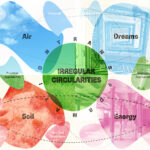

The international Summercamp is divided into four thematic areas: soil, energy, air and dreams. International students and early career practitioners from the fields of art, architecture, design and related disciplines are invited to spend 10 days exploring the circular economy and future transformation potential in the context of the following four projects:
1. Soil: “Brick Factory”
A practice-oriented project that understands soil as a distinctive resource which combines material research, craftsmanship, and spatial experimentation. Throughout the Summercamp, a temporary Brick Factory will be established in which production, use, and disposal are equivalent phases and make circular thinking spatially, materially, and performatively tangible.
2. Energy: “New (Mobile) Working Environments”
An experimental, practice-oriented project that focuses on how energy (whether human, technical, or digital) can be generated, used, and transformed, and what forms of work result from this. This project invites participants to explore notions of contemporary work environments through performative and installative living and working experiments, or through scenarios in which human movement, interaction, or creative practice generate energy.
3. Air: “Exchange Market”
An experimental, practice-oriented project that understands air as an indicator and symbol of change and circulation: an invisible force that enables flow, exchange, movement, and dependencies between people, things, and spaces. This project focuses on sharing and exchanging as a circular principle and invites participants to simulate an exchange platform as an installative and performative structure where value is negotiated by use and need.
4. Dreams: “Cartographies of Dreams”
An artistic, speculative project that understands dreams and desires as productive forces for designing possible future scenarios, visions, and alternative models of coexistence. By understanding dreams as imaginative raw material, the fourth project invites participants to artistically excavate, formulate, and translate dreams and wishes into a collective cartography of possibilities.
During the Summercamp, all participants will be provided workspaces, temporary accommodation in Zeitz, and a meal allowance, but must cover their own travel to and from Zeitz. The participants are expected to be present on site for the entire duration of the Summercamp to contribute to the collective work on one of the four projects presented above. The camp will be conducted in English and German, as language barriers can be part of the adventure.
Applications can be submitted until 19 February 2026 and must include
– a short biography (150 words)
– up to 5 images of current (student) projects
– and a letter of motivation (350 words) on at least one (preferably two) of the four projects mentioned above.
All documents must be sent to Daniel Springer (summercamp@bauhaus-dessau.de) by 19
February 2026. Questions about the summer camp can also be sent to this email address.
All application documents should be submitted as a single PDF file (max. size 10 MB).
Selected candidates will be notified by 27 February 2026.
The complete summer camp programme (including all workshops, keynotes and lectures) will be published in March 2026.