Radio plays

Radio plays

Radio plays

As a radio playwright, I was particularly interested in creating an acoustic version of the vast world of the Bauhaus and making it possible for children to experience complex interrelationships in a playful way. (Angi Vukorep-Harrer, Author)

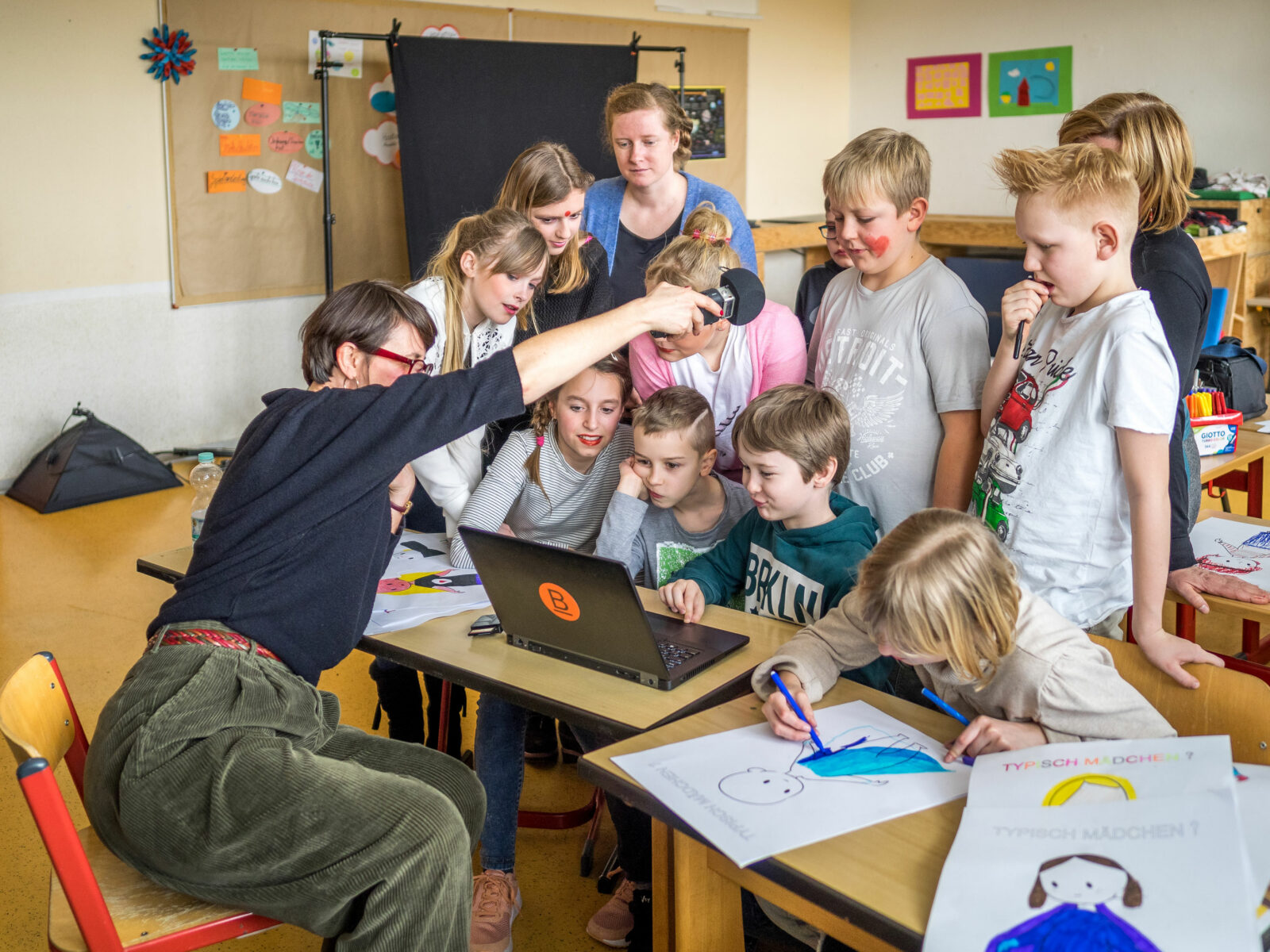
The sound collages in the media library are created as part of the Bauhaus Dessau Foundation’s artistic and educational projects. They stem from an exploration of the respective works as well as fundamental themes such as materials, light, space and creative processes.

The audio pieces bring together different perspectives: they give voice to impressions, experiments and approaches – sometimes from the participants’ point of view, sometimes as independent artistic works. In this way, they open up a variety of approaches to the content and questions of the Bauhaus

The audio plays were recorded in German.

Glass embodies the promises of modernism like no other material: transparency, hygiene and lightness. The radio play takes us from the “glass kitchen” through the Bauhaus’s design experiments to the curtain wall of the Bauhaus building in Dessau. Historical audio clips, fictional scenes and the voice of glass combine to form an acoustic narrative about faith in progress, industrial reality and the contradictory history of a seemingly immaterial material.

Author & Narrator: Ben Garit Hernandez
Compositions & Sound Design: Gabriel Wörfel
What does concrete tell us about modernity, work and society?
This radio play takes us to the construction site of the Bauhaus in Dessau and explores the history of a material that fundamentally transformed architecture and thinking in the 20th century. Historical audio clips, fictional scenes and the voice of concrete come together to form an acoustic collage about new beginnings, enthusiasm for technology and the dark side of construction – from reinforced concrete as an avant-garde material to today’s questions of sustainability and future viability.

Author & Narrator: Ben Garit Hernandez
Compositions & Sound Design: Gabriel Wörfel

This audio piece takes you on an auditory journey into the world of iron and steel. It brings to life just how closely these materials are linked to industrial development, everyday culture and building practices.

Author & Narrator: Ben Garit Hernandez
Compositions & Sound Design: Gabriel Wörfel

This 20-minute radio play is about the Bauhaus as a school from the students’ point of view. The radio play is based on a two-year research project by the Liborius and Philanthropinum grammar schools in Dessau, in the course of which song texts, compositions and dialogues on the subject of the Bauhaus were created in various workshops. These were the basis for a libretto about the Bauhaus, which was rehearsed and performed in a second step with a children’s choir, school band and student soloists. The pupils reflected on their research and rehearsal work at the microphone. Researcher Katja Klaus and various speakers guide the listener through a colourful audio collage of information, reflections and associations about the Bauhaus institution.

How can you create affordable and attractive living space? This audio play provides the Bauhaus answer to this question, which is still pressing today: with precisely timed housing construction using prefabricated components. Between 1926 and 1928, a housing estate with over three hundred modern terraced houses was built in Dessau-Törten according to the assembly line principle, which was later expanded to include three-storey pergola houses with optimised flat layouts.

In this audio collage, the pupils of Year 4 at the Evangelische Grundschule Dessau (Protestant Primary School Dessau) explore the life and work of Oskar Schlemmer – from their own perspective. As a basis, they worked on two project days on the Bauhaus stage and in the workshop in the Bauhaus building. They were accompanied by radio playwright Angi Harrer-Vukorep, actress Anke Stoppa and Torsten Blume, research assistant at the Bauhaus Dessau Foundation.

The polyphonic sound collage on the life and work of László Moholy-Nagy incorporated the pupils’ studies and their experiences experimenting with light and materials. The children explored the technique of the photogram and reported on their experiences and insights. The moment of their own practical experience thus becomes the focus of attention and forms the content of the audio piece.

In the audio pieces, you will learn how the Bauhaus became Marianne Brandt’s artistic home and how she had to fight for her equal rights here. Marianne Brandt worked mainly in the metal workshop, took over its management for a time and revolutionised the design of lighting fixtures.

In the audio pieces, you will learn how the Bauhaus became an artistic home for Gertrud Arndt and how she had to fight for her equal rights here. Gertrud Arndt studied in the weaving workshop at the Bauhaus in Weimar and became a pioneer of conceptual photography with her staged self-portraits during her time in Dessau.