
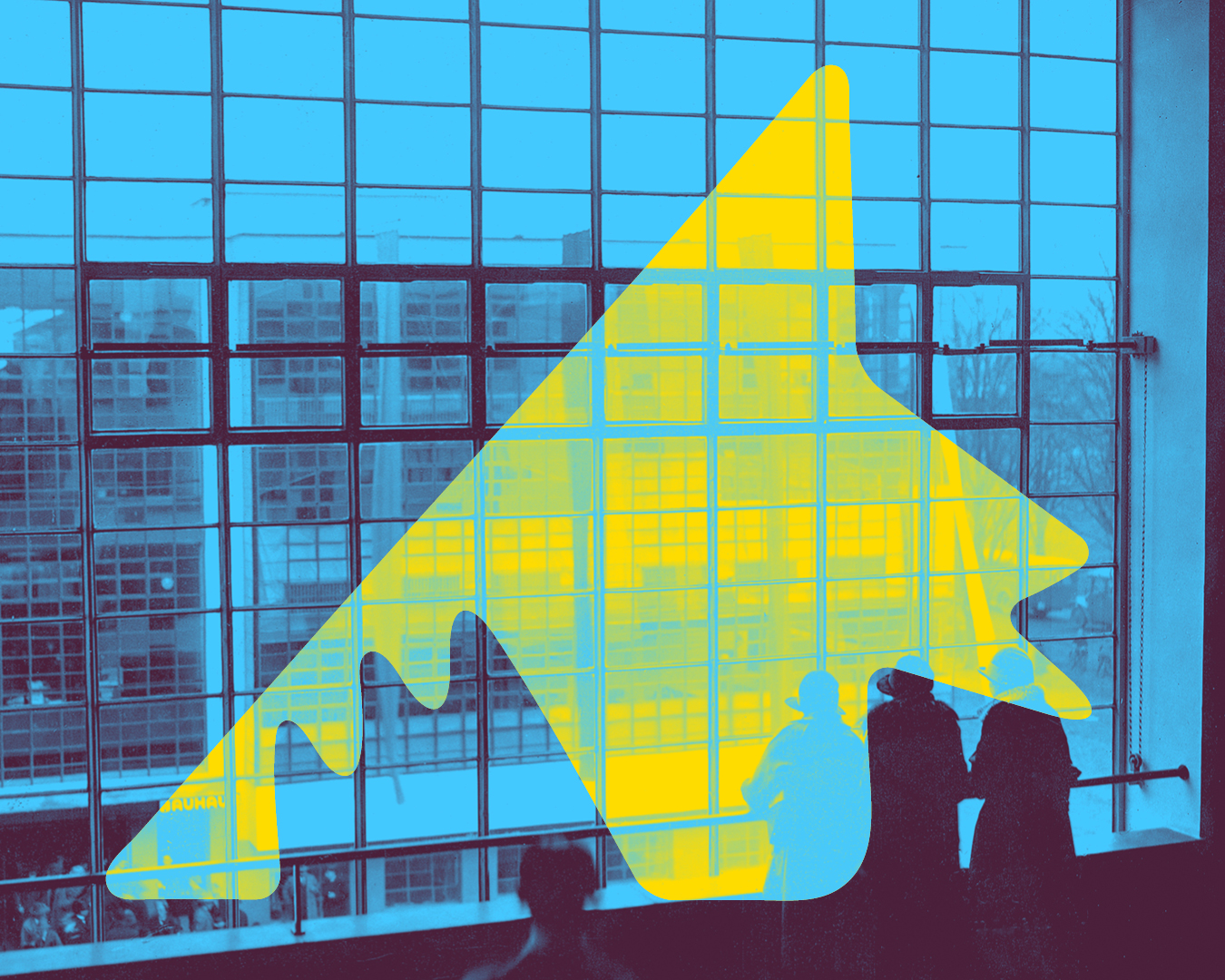
Projections | Promises | Echo

Projections | Promises | Echo

The two-day event celebrates two openings: on 4 December 1926, the Bauhaus Building in Dessau was inaugurated. Fifty years later, on 4 December 1976, the iconic building was reopened as a Scientific and Cultural Centre.

To mark the 100th anniversary of its opening, we invite you to the Bauhaus Building on 4 December to celebrate this anniversary with a programme of artistic performances and interactive activities. With its varied uses and institutional transformations right up to the present-day foundation, the Bauhaus Building acts as a resonant space for a multitude of memories.

On 5 December, a discussion forum at the Bauhaus Museum Dessau will explore the institutional legacy of the Bauhaus Dessau as an example of the cultural-political challenges facing cultural and educational institutions, both historically and in the present day. Following the discussion forum, the opening of the exhibition “Exhausted Narratives” will take place in the evening, in which the role of the Bauhaus Building in shaping the historiography of modernist architecture will be subjected to critical examination.


Fri 4 Dec 2026, 4 – 9 pm
Birthday celebration

“A Building enters the Stage”
Bauhaus Building


Sat 5 Dec 2026, 10 am – 9 pm
Discussion forum
“Cultural venues as spaces of resonance”
Bauhaus Museum Dessau
+ exhibition opening 
Exhausted Narratives

Admission is free on both days at the Bauhaus Museum Dessau and the Bauhaus Building

Birthday celebration
: “A Building enters the Stage”

Programme overview:

4 pm
Opening and welcome address
4:30 pm – 8 pm
varied programme
5 pm
To the Core – Bauhaus Dessau 100 // Book presentation
8 pm
Freemahler – What the Earth tells us // Concert on Stage
9 pm
I Dream of Canteens // Performative Activation at the Canteen
> > > > >
See the detailed programme below

2:30 pm > Meeting point: Bauhaus Museum Dessau
Mosaics. Tiles. Glass // City walk

In Dessau city centre, Bauhaus student Carl Marx left his mark in the 1950s and 60s; traces of this are still visible to a greater or lesser extent today and can be discovered on this walk with Bettina Schroeder-Bornkampf. Duration: 90 mins


4 pm > Bauhaus Building Auditorium
Opening and welcome address
Barbara Steiner, Director and CEO of the Bauhaus Dessau Foundation, and Robert Reck, Lord Mayor of Dessau-Roßlau

Flashback // Puppet show performance with Suse Wächter
Puppeteer Suse Wächter brings the Bauhaus itself to speak and, drawing on Ise Gropius’ diary entries, reminds us of the facts and fun, the moods and encounters surrounding 4 December 1926.


4:30 pm – 8 pm
Related programme running throughout
>>> see below


5 pm > Design shop
To the Core – Bauhaus Dessau 100 // Book presentation
with Theresia Ilchmann, Katja Klaus, Tanja Milewsky, Flora Selunka and Barbara Steiner, as well as Heimann + Schwantes

The editorial team, designers and editor will provide insights into the wide range of topics and the production process behind this centennial publication, which has just come off the press. The book is published in German and English. Following the presentation, visitors can try out illustrator Carla Lou West’s “Perception Generator”.


6 pm > 2nd floor, Room 2.42
Song from the last Bauhaus Festival // Video draft and discussion
Discussion with Anne Berrini and Wolfgang Thöner

When the Bauhaus reopened in Dessau in 1976, former Bauhaus student Carl Marx painted an unusual picture. The video draft explores this contradictory work and reveals the story behind its creation.


8 pm > Stage
Freemahler – What the Earth tells us // Concert
with the Stegreif Orchester

The Stegreif Orchestra combines various compositions by Gustav Mahler on the beauty of nature with the question of how we can preserve our planet for the future. Through their own arrangements and improvised sounds, Mahler’s melodies meet new musical ideas.


9 pm > Canteen
I Dream of Canteens // Performative Activation
Mit Paula Erstmann und Gosia Lehmann

The canteen is situated directly behind the Bauhaus Stage. Paula Erstmann and Gosia Lehmann invite you to a birthday dinner: together with the audience, they will bring the Bauhaus canteen to life and continue the story of this central space.

Supporting programme

4:30 – 7 pm, ongoing > Canteen
Day trip to Torten (Cakes) // Workshop
with Wolfgang Drews and Norbert George

The programme for the opening of the Bauhaus Building on 4 December 1926 included a tour of the Dessau-Törten Housing estate. 100 years later, the estate features in the form of pastries: Wolfgang Drews and Norbert George are building gingerbread houses with visitors, loosely based on the architecture of the Haus Anton. The two talk about their vocational training in the Bauhaus Building – as confectioners.


4:30 – 7:30 pm, every 20 minutes > Entrance by the Bauhaus letters
The pinnacle of modernism // Building hike
with Datenstrudel (Joern Hintzer & Jakob Hüfner) and Mirko Muhshoff

In keeping with Walter Gropius’s maxim that “a building can only be understood through movement”, Datenstrudel present new perspectives and insights in their exploration of the building. Their expedition involves precarious balancing acts, the risk of falling, and a constant up-and-down journey, culminating in a view to Weimar and Bernau – high up on the roof of the studio building.

The number of participants is limited to 10 per session. You are not permitted to bring bags. A building hike takes around 30 minutes.


4:30 – 8 pm, ongoing > Stairwell + Director’s Office, 1st Floor, Bridge
Tilting Figurines // Public walk-through
with Amateurtheater Wolfen and Andreas Hillger

The Bauhaus Building has been inaugurated on more than one occasion – with a grand celebration in 1926 and a “quiet handover” following its reconstruction in 1976. To mark its 100th anniversary, prominent witnesses to that era will be mingling with the guests to reflect on those times – and to talk about the future.


4:30 – 8 pm > 2nd floor, Workshop Wing, Room 2.20
Bauhaus menu reloaded: seasonal + local! // Culinary performance
with Urbane Farm Dessau

The “festive menu” from the 1976 reopening, featuring crab cocktail and “Kraftbrühe royal”, was intended to mark the special occasion. But what did the Bauhaus students actually eat in 1926? We know from the canteen records that at that time, simple and filling dishes were served, made with whatever was locally and seasonally available. The Urbane Farm builds on this tradition and invites you on a journey into our culinary future.


4:30 – 8 pm, ongoing > 2nd floor, Bridge, Exhibition: “Lernort Bauhaus”
Birthday mail // Open workshop
with Nicole Grimmm and Anne Schneider

Collages, photomontages and advertising were regarded by many Bauhaus artists as important and contemporary means of expression. They used them to comment on social and political events and to take a stand on key issues of the time. Following the example of the historic Bauhaus, participants can create their own works on postcards, using collage to express their views on a current topic.


4:30 – 8 pm, ongoing > 2nd floor, Corridor North Wing,
Great Narratives? A Cross-Reading of Bauhaus Books // Book exhibition
with participants from Bauhaus Lab 2026: James Blue, Namika Hamahashi, Madeleine Hykes, Pascale Mondion, Karolína Plášková, Hira Rasool, Pappal Suneja, Luciana Varkulja

There is not a single book on the history of modern architecture that does not mention the Bauhaus building. However varied the narratives may have been, the Bauhaus has helped shape the canon of modern architecture. This year’s Bauhaus Lab examines these master narratives. In a book exhibition designed for cross-reading, visitors are invited to discover the open-ended nature of these stories.


4:30 – 8 pm, ongoing
> within the exhibition sections on metal: basement, concrete: 1st floor, Room 1.22 and glass: 2nd floor, Room 2.22
New Connections // Educational programme
with Philipp Keidler, Lissy Willberg, Verena Zimmermann

Glass, concrete and metal shape not only Bauhaus architecture but also everyday life. In the exhibition Glass | Concrete | Metal, “New Connections” opens up sensory approaches to these materials: How do they feel? How do they sound? And what happens when we get “to the heart of the matter”? Education officers encourage discussion, show material samples and provide insights into the properties of the materials through short demonstrations.


4:45 pm – 7:45 pm, every 30 minutes > 2. OG, Room 2.30
Bauhaus-Szenarien 1926–1989 // Mitmach-Performance
with Teresa-Louise Häußler and Jakob Herrmann

This participatory performance invites you to re-enact famous photographs from the Bauhaus era. As an icon of modernism, the building is one of the most extensively researched in the world, but what actually happened inside, and how was it used after the famous school was forced to close?


from 5 pm onwards > North wing façade
50/50 // Fotoprojektionen

Throughout the evening, a projection on the façade of the North Wing will display a selection of photographs from the two events that, 50 years apart, were pivotal to the perception of the Bauhaus: the building’s inauguration on 4 December 1926 and the state ceremony marking its reopening following the first restoration in accordance with heritage conservation standards on 4 December 1976.

Discussion forum: “Cultural venues as spaces of resonance”

The Bauhaus is a resonant space for diverse activities, cultural ideas, ideological appropriations, organisational realities and political constellations, within which the Bauhaus Dessau institutions operated. These diverse institutional realities remain present in Dessau’s local cultures of remembrance to this day: the Bauhaus was a place of vocational training, a leisure venue and a meeting place, whilst also offering space for artistic experimentation. Its reopening in 1976, under the auspices of the City of Dessau, took place against a backdrop of cultural liberalisation and democratisation occurring both nationally and internationally. An increasing number of modern, multifunctional cultural buildings were emerging in Eastern and Western Europe. On the one hand, these became cultural venues that opened up spaces for leisure, enjoyment and creative expression.

On the other hand, these openings in the cultural and leisure sectors in the GDR were fragile political manoeuvres aimed at safeguarding the dwindling legitimacy of the political system. In this context, the Bauhaus Dessau emerged as a cultural centre which, alongside state-sanctioned design and educational work, also created spaces for subversive artistic and creative activities.

This event invites the Dessau community, local stakeholders, cultural practitioners, experts, and visitors to come together to discuss the institutional legacy of the Bauhaus and its special significance for the present day, and to understand the institution as a multifaceted place of remembrance as well as a widely interconnected platform for cultural co-productions. We would like to engage in a dialogue with participants about how this institutional legacy can be harnessed for the future of cultural institutions.

Programme

> > > Simultaneous interpreting into German will be provided for the English-language contributions to the discussion forum.

Programme overview:

10 am
Welcome and introduction: Barbara Steiner
10:30 am – 1 pm
Panel: Committed to the public – cultural venues and their responsibilities
2 – 4:30 pm
Panel: A contested legacy – multivocality
5 – 7 pm
Round-table discussions: Keeping things moving. Institutions as diverse, united and democratic structures
7 pm
Exhibition opening: ‘Exhausted Narratives’

10 am
Welcome and introduction
Barbara Steiner, Director and CEO of the Bauhaus Dessau Foundation


10:30 am – 1 pm
Panel 1
Committed to the public – cultural venues and their responsibilities

The history of the Bauhaus is characterised by its international orientation and the fusion of diverse conceptions of modernity. Migration and transcultural exchange have, to this day, given rise to a diverse, polyphonic history: the Bauhaus exists only in the plural. At the same time, the institution was under political pressure throughout its existence. Outreach, dialogue and international networking were therefore crucial to gaining support.

In light of the global rise of right-wing populist movements and nationalist cultural policies, the panel explores how cultural institutions are addressing these developments and what scope for action is available to them. Voices from local and international contexts come together to exchange experiences and discuss perspectives on cultural work under these conditions. The focus is on the exchange of experiences between the institutions and on the question of how alliances can be built and sustained, both within Saxony-Anhalt and beyond its borders.

Moderator: Greta Taubert

10:30 am
“Loss of the Centre” and the Fear of Modernity. Resentment towards “the Avant-garde” in the Second Bauhaus Period // Keynote talk
Justus Ulbricht

11 am
Rewriting Design Education: 66 years of the NID in India // Keynote talk
Tanishka Kachru

11:30 am – 1 pm
Panel discussion
Katalin Erdődi (Trafó House of Contemporary Arts, Budapest), Barbara Steiner (Bauhaus Dessau Foundation), Maik Reichel (State Agency for Political Education, Saxony-Anhalt), Annegret Laabs (Kunstmuseum Kloster Unser Lieben Frauen, Magdeburg), Iris Edenheiser (Forum for Contemporary History, Leipzig)


1 – 2 pm
Lunch break


2 – 4:30 pm
Panel 2
A contested legacy – multivocality

The Bauhaus Dessau is a cultural heritage institution that sees itself as an open forum for participation in collective memories and for plural identities.

To speak of the Bauhaus today is to enter a narrative space characterised by diverse interconnections: shifting references to the Bauhaus point to different political, geographical and cultural contexts, as well as divergent approaches to history. This applies equally to its institutional history.

The question is how history is interpreted, whose history is told and who is involved in the respective historiographies. It is also of interest how cultural heritage institutions can develop today as spaces for a diversity of voices. Cultural heritage is currently being exploited by various political camps for their own cultural-political agendas. The National Socialist critique of modernity directed at the Bauhaus, which has been revived by right-wing movements, should be seen as a sign of this. How do cultural heritage institutions, as spaces characterised by openness and diversity in their approach to history, position themselves in relation to an exclusive understanding of culture that is oriented towards a dominant national culture?

Moderator: Regina Bittner

2 – 2:30 pm
The Lingering Influence of the Past: A Re-examination of the History of the Bauhaus Colloquia in the GDR
Rixt Hoekstra

2:30 – 3 pm
Inspired by the Bauhaus: Progressive Art in Hungary in the 1960s and 1970s
Éva Forgács

3 – 4 pm
And then the present: what does it tell us as we move through it? // A performative tour of the Bauhaus Museum Dessau

Artist Angelika Waniek invites you to explore the Bauhaus legacy through the ages, perspectives and narratives of contemporary witnesses, whilst contributing your own view of the Bauhaus in Dessau.

4 – 4:30 pm
“Exhausted Narratives”
Bauhaus Lab 2026

The Bauhaus owes its prominent position in the historiography of modernism not least to photography. Images of the building feature in numerous key works on 20th-century architecture. Drawing on the photographic record, participants in the Bauhaus Lab 2026 programme will examine the mechanisms of canon formation in the architectural history of modernism. Building on these historical narratives, they will explore whether, and to what extent, we still need narratives today.


4:30 – 5 pm
Coffee break


5 – 7 pm
Round-table discussions
Staying on the move.
Institutions as multifaceted, solidarity-based and democratic structures

Moderator: Ronja Kindler

In conversation with: Aljoscha Begrich – OSTEN Festival for Art and Mutual Interest, Mandy Gehrt and Kseniia Shachneva – Bauhaus Agents, Reallabor ZEKIWA Zeitz, Lisa Glanz – Rat & Tat Agency for Volunteering, Wencke Hamann – VorOrt e.V., Mika Kaiyama – LAMSA e.V., Sandra Düsterhöft, Seniorencampus VHS Dessau

What must our institutions look like in future to be, and remain, flexible, pluralistic, solidarity-based and democratic spaces? And how can new alliances and avenues for cultural co-production be developed? The Bauhaus Dessau serves as an example here: as a hybrid institution combining the roles of school, enterprise, cultural centre and venue, it was from the outset a flexible structure and a framework for addressing contemporary issues of time and design, supported by a succession of different sponsoring bodies. As part of a series of round-table discussions, representatives of regional initiatives and institutions are invited to act as hosts and engage in dialogue about the present and future of their own institutions: How do we shape spaces, and what do we need from one another to remain flexible, diverse, united and democratic? What should we join forces for, and what can we work on together?


7 pm
„Exhausted Narratives. Trangressing the Pioneers of Modern Movement “ // Exhibition opening

More about the exhibition

Sponsors:

The event on 5 December 2026 is being organised as part of a partnership with the Federal Agency for Civic Education.

Logo bpb. Federal Agency for Civic education
