c
Material from the anniversary year ‘To the Substance’, macro photograph, 2024
© Bauhaus Dessau Foundation / Photo: Meyer, Thomas, 2024 / OSTKREUZ
Public Conference:
Discourse | Cracks | Narrative. Bauhaus Matters: Materials of modernity
1:30 – 3:30 pm
Panel 2: Architecture of the construction industry
Presentations and discussion
Moderated by Stephan Pinkau
(Anhalt University of Applied Sciences)
Speakers:
1:40 pm Kim Förster (University of Manchester)
2:10 pm Monika Motylińska (Leibniz Institute for Research on Society and Space)
2:40 pm Katie Lloyd Thomas (Newcastle University)
Kim Förster
Polysius and the Bauhaus: Industrial Development, Global Markets and Cement Modernity
The industrial history of the G. Polysius AG, established as a machine manufacturer and iron foundry based in Dessau and a leading supplier of cement plants in the first half of the twentieth century, is exhibited in a side room of the Technikmuseum Hugo Junkers Dessau with models and documents. While the connection between the Junkers aircraft manufacturer and the Bauhaus have been extensively studied, Polysius‘ history and its relationship with the architecture school remain underexplored. This paper explores Polysius, with a particular focus on technological development, environmental and material aspects and its impact on architecture culture in the Bauhaus era. Using the installation and narrative found in the Junkers museum, complemented by archival research at the Landesarchiv Sachsen-Anhalt (state archives of Saxony-Anhalt), the paper traces the development of production conditions for the cement and building materials industries. Polysius, specialised in cement machinery from 1887 onward, rapidly gained dominance, achieving a monopoly in the German Empire by 1904 and emerging as market leader in Europe prior to the First World War. This analysis considers the interplay between the metabolism of “cement modernity” and the emerging “cement culture” associated with the Bauhaus that facilitated industrial progress. The economic and ecological trajectory of Polysius, a family-owned enterprise that entered the international scene following participation in the World’s Columbian Exposition in Chicago in 1893, where it introduced the rotary kiln to Europe, provides insights into the global networks centred in Dessau. Notably, the company exported cement plants as products to Egypt and China and expanded its global market in the second generation of leadership. Further, the paper investigates the responses of the third generation to the economic crises of the interwar period, the development of an international network of sales agents and the attempts of the company to enter the North American market through a plant in Bethlehem, USA. Innovations such as the Lepol kiln, which reduced fuel consumption and lowered material costs, and the redesign of advertising materials in line with Bauhaus graphics were transformative. Despite limited archival documentation, evidence suggests that Polysius distanced itself from the Bauhaus, its organisation and pedagogy in the early 1930s in the context of the rise of fascism in Dessau and throughout Germany. While the Bauhaus was forced to close in 1933, Polysius continued operations until 1943, supplying nearly 500 cement plants, and remained a vital industry supplier. The side room exhibition shows that the cement works reemerged in the German Democratic Republic, playing a significant role in the socialist cement industry and international trade.
Kim Förster is Senior Lecturer in Architectural Studies at the University of Manchester, specialising in knowledge and cultural production as well as environmental, energy and material history. Former Associate Director of Research at the Canadian Centre for Architecture in Montréal, he is the author of Building Institution (2024) and Undisciplined Knowing (2022) and the editor of Environmental Histories of Architecture (2022). He currently researches, teaches and exhibits on the subject of cement modernism and cement culture and has contributed articles and essays to Überbau (2021), Beyond Concrete (2022), Werk, Bauen und Wohnen (2022), Solarities. Elemental Encounters and Refractions (2023), e-flux Architecture (2023), Oase (2025) and Desire and Denial (2025).
Monika Motylińska
Cementing Imperialism/Extractivism. A Success Story from Dessau?
The most globally successful export product from Dessau has not been Bauhaus, but rather machinery for cement plants, at least if the sources of the local manufacturer, G. Polysius, are to be trusted. Production of cement became a conditio sine qua non and a meta-infrastructure for imperial expansion in the long twentieth century (Fivez Motylińska 2022), and Polysius capitalised on the steadily rising need for this material, both by aligning itself with the German colonial project and by seeking customers in the global arena via a wide network of representatives and a presence at trade fairs. This talk shall focus on the ventures of the company into sub-Saharan Africa in the first half of the twentieth century, beginning with plans for a cement factory near the port city of Tanga in German East Africa (now Burundi, Rwanda, the Tanzanian mainland and part of Mozambique), which were of vital importance for German territorial conquest and were later adopted by British and then Tanzanian actors. From there, it will move to Lubudi, where a Lepol kiln designed in Dessau became a high-end technology in the service of the Belgian extractive agenda in the Katanga region (now in the Democratic Republic of the Congo). Finally, it will continue to Bulawayo in Southern Rhodesia (now Zimbabwe) to interrogate entanglements between cement production, infrastructure
projects and power structures in Southern Africa. Grounded in archival sources from Dessau, Brussels and Johannesburg, this talk aims to demonstrate how the addiction to cement (Motylińska Fivez 2024) has been integral to the imperial ambitions and undertakings of racial capitalism (Leroy Jenkins 2021). Yet, it also scrutinises how the entrenched extractivist approach (Andermann 2023) to industrialised, large-scale production of ubiquitous construction materials has surpassed particular political settings and the agendas of individual actors, thus making it seem inevitable.
Monika Motylińska is an architectural and urban historian interested in cycles of architectural production in the long twentieth century, especially in the Global South. Since January 2022, she has headed an interdisciplinary research group, Histories of the Built Environment, at IRS Erkner (tenured). Between 2019 and 2022, she was a fellow of the Centring Africa research programme. Since 2020, she has taught at the Institute for European Urban Studies at Bauhaus-Universität in Weimar. Between 2017 and 2019, she was an external lecturer at the Center for Metropolitan Studies, TU Berlin. She recently co-edited the volume Between Solidarity and Economic Constraints. Global Entanglements in Socialist Architecture and Planning in the Cold War Period (Boston, Berlin: de Gruyter 2023) together with Christoph Bernhardt and Andreas Butter. Abstract for Bauhaus Matters: Materials of Modernism, 29–31 January 2026
Katie Lloyd Thomas
Specifying Crittall’s Windows: Architects, building products and labour at Silver End, Essex and Dessau-Törten
Among the extraordinary collection of building fragments of the Bauhaus construction research archive are five metal window frames produced by Fenestra Crittall AG, Dusseldorf. They come from different phases of the Dessau-Törten Housing Estate (1927, 1928), with which both Walter Gropius and then Hannes Meyer were involved. Crittall’s windows (not used at the Bauhaus School as is often erroneously claimed) were notable for their ‘Fenestra’ joint, the patent for which the Essex-based company purchased from the Dusseldorf Fenestra Fabrik in 1909. These enabled the development of ultra-slender windows and mass production, which would
propel Crittall into international production and global fame. Crittall’s windows were showcased throughout the varied architectures of Silver End, the Essex village that was built by the company to house its factory workers and is also celebrating its centenary in 2026. This paper will draw on my extensive research into Crittall to explore two key questions. First, bearing in mind Sérgio Ferro’s understanding of the unique role of construction as a major supplier of surplus labour, the workforce of which must at the same time be subordinated to techniques that include some undertaken by architects, how should we understand the rise of building products following the First World War and the factory as a new site of building labour? Second, to what extent did architects like Gropius and Meyer (Dessau) or Charles Quennell and Thomas Tait (Silver End) do more than simply specify the products of manufacturers like Crittall? Can we understand architects in this period as ideologues, providing aesthetic, technical and cultural rationales to support the expansion of the building product industry?
Katie Lloyd Thomas is a visiting professor at Newcastle University, UK. Her research is concerned with gender, labour, materiality and technology and their intersections with architectural concepts, practice and design. She is the author of Building Materials: Material theory and the architectural specification (Bloomsbury, 2021) and was PI for the joint UK/Brazil project Translating Ferro / Transforming Knowledges of Architecture, Design and Labour for the New Field of Production Studies from 2020–2024.
c
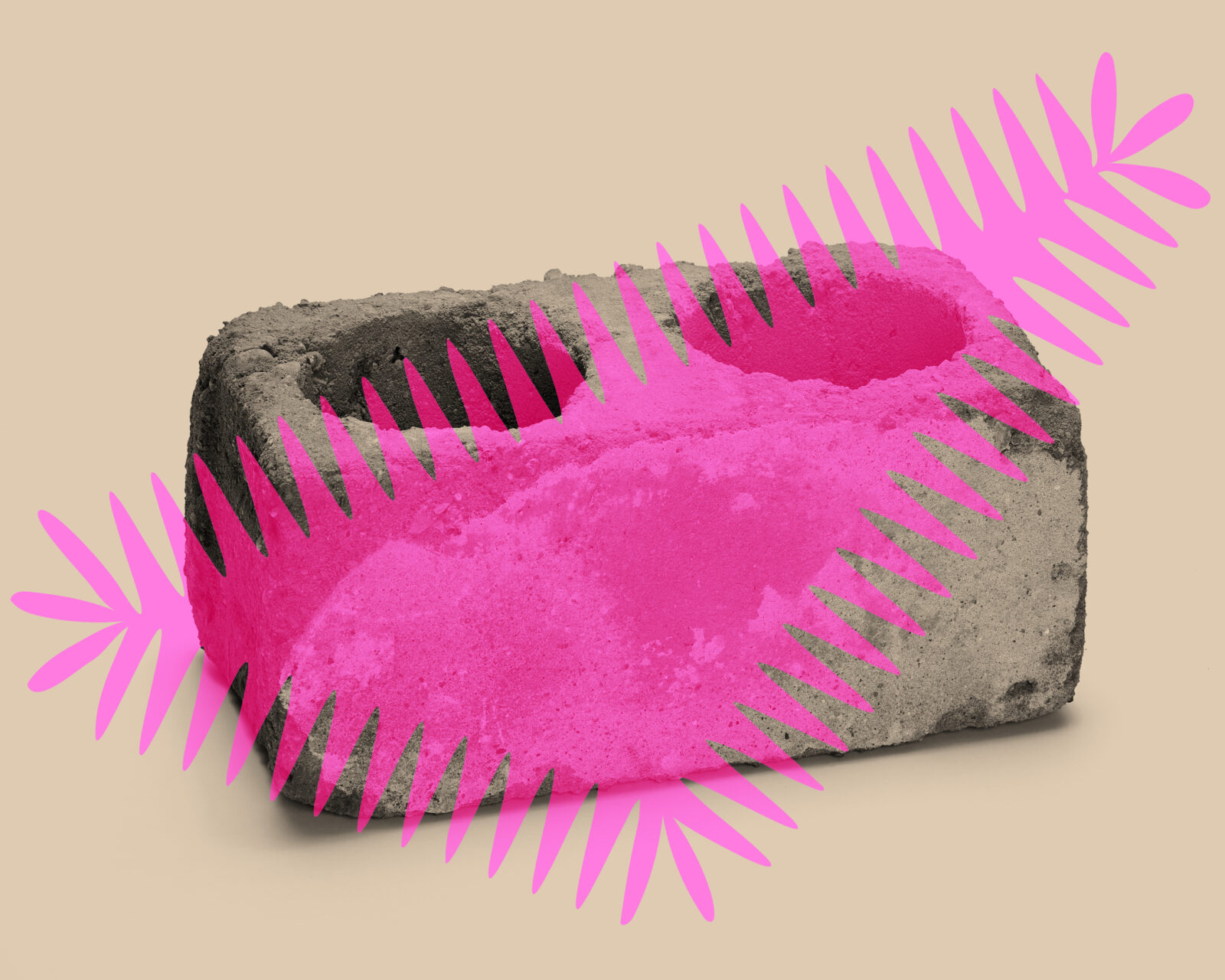
Slag concrete hollow block from the Mittelring 14 housing estate in Dessau-Törten, 1928 (coloured)
© Bauhaus Dessau Foundation / Photo: Gunter Binsack / Graphic: Heimann + Schwantes